By Alex Lenferna
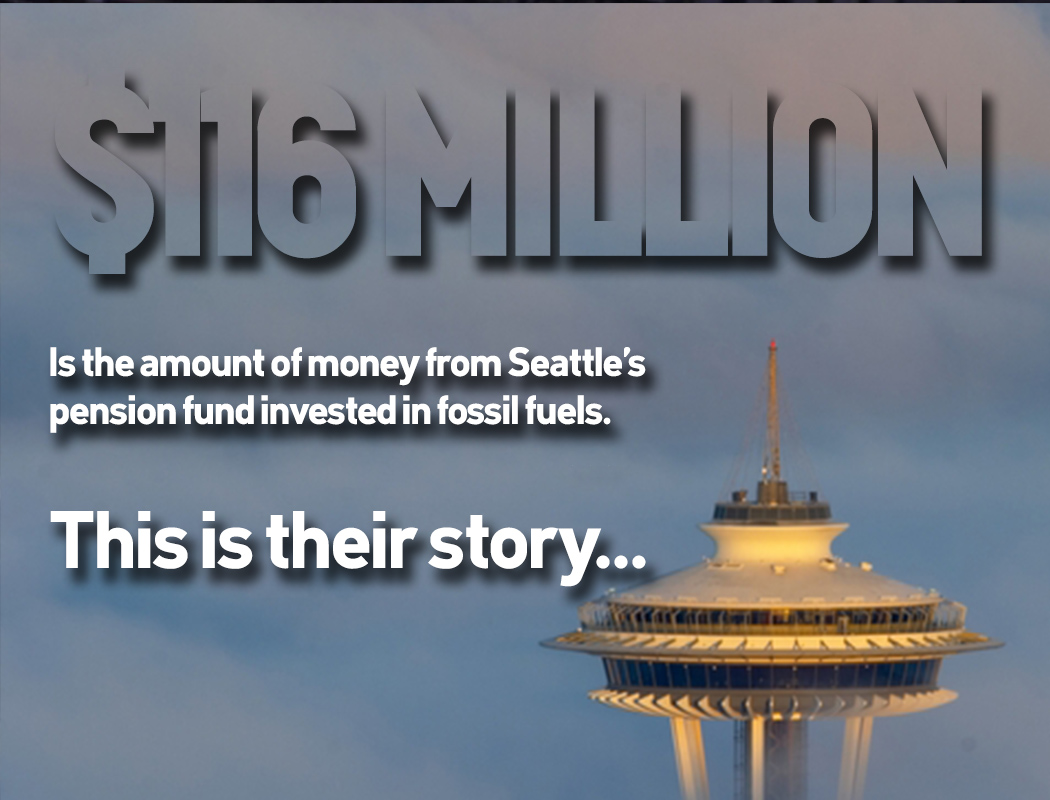
A growing number of divestment campaigners have had the experience of fighting against reports from investment advisers which argue against divesting from fossil fuels. Likewise, here in Seattle, where we’ve been working hard to get the Seattle City Employees Retirement System (SCERS) to consider divesting from fossil fuels, our efforts were almost derailed by a report which advised against divestment. Too many groups have had their efforts derailed by such reports, most recently American University, so I’m writing this article because I think the time for bad reports on divestment needs to end so that institutions and campaigns can have a clearer understanding of divestment and the risks they face by staying invested in fossil fuels.
Last week NEPC, one of the financial industry’s largest independent investment consulting firms, delivered a report to SCERS. Their recommendation was not to divest from fossil fuels citing uncertainty about the future as their main reason for not divesting. However, their picture of uncertainty and most of their report was arguably quite one-sided. I am not sure what drove them to write such a one-sided report, but nonetheless it is worth demonstrating some of the flaws therein so that other campaigners can recognize them if they are faced with a similar situation, and perhaps even investment advisers might even take some of this into consideration.
One of the biggest problems of the report boils down to a major assumption which allowed them to deny the existence of carbon risk for SCERS. NEPC based their analysis on a financial theory called efficient market theory, which assumes that market participants have all the necessary information about the market which they use efficiently, such that all shares are properly valued. Assuming such a hypothesis in the face of a bubble seems irresponsible, as bubbles are based on the idea that shares are erroneously over-valued and that markets are not acting in accordance with efficient market theory. Furthermore in the case of the carbon bubble efficient market theory is not empirically supported for even if markets used information efficiently, all the information regarding carbon risk just is not available. For instance, the 2013-14 Asset Owner’s Disclosure Project’s Global Climate Index Report found that just under 80% of asset-owners are failing to properly manage climate risks, making them vulnerable to the risks of the carbon bubble, which are estimated to add up to potentially $28 trillion worth of losses in just the next two decades according to analysis by Kepler Chevereux.
Perhaps NEPC felt justified in using efficient market theory because they thought that everything is hunky dory with the fossil fuel industry based on their perception that stranded assets come about primarily as a result of regulatory action to stop climate change, which they were (perhaps unwisely) asking SCERS to bet against. However, the possibility of stranded assets comes from more than just the possibility of regulatory action; the fossil fuel industry is in trouble from a range of independent and mutually reinforcing factors, such that regulatory action may just be the proverbial straw that breaks the camel’s back. In a report we sent to NEPC we outlined in detail how the fossil fuel industry is in increasing trouble thanks to a combination of factors, including the rapid decrease of alternative energy costs, increasing costs of fossil fuel extraction, increases in energy efficiency, changing social norms, increased environmental regulation, and suppressed growth of fossil fuel demand in key economies. Ambrose Evans-Pritchard just wrote a great piece on the possible decline of the fossil fuel industry.
In the face of these worrying signs of decline for the fossil fuel industry, uncertainty about the future is an argument that does not clearly point against fossil fuel divestment, but arguably in favour of it. However, instead of recognizing this NEPC cherry-picked a few reports which would suggest that fossil fuel divestment will increase risk and reduce returns to a portfolio. They conveniently chose to ignore an MSCI study which concluded that “fossil fuel divestment has the potential to reduce overall portfolio risk because of Energy Sector volatility”; or a recent Aperio report which showed that fossil fuel divestment does not have a significant effect on potential return or risk; or that the fossil free U.S. Russell 3000 index outperformed the Russell 3000 index 68% of the time between 1988 and 2013; or the fact that the fossil fuel industry has underperformed the market ever year for the past five years, representing a possible shift in the profitability of staying invested in fossil fuels.
Of course, in any good bad report on fossil fuel divestment, fiduciary duty will be used as a tool against fossil fuel divestment proponents. In response, as always, I turn to former SEC Commissioner Bevis Longstreth who has convincingly argued that “betting against the stranding risk [of the carbon bubble] materializing is arguably an irresponsible, hard-to-defend, position for a fiduciary, who will have to demonstrate a sound basis for doing so, something that seems hard to do”. Similarly, a report by Mercer concluded that “given the risks and opportunities presented by climate change and the rapid introduction of carbon pricing regimes across multiple jurisdictions, trustees have a clear duty to consider climate change risks and relevant laws and policies in making investment decisions”.
As researchers from Oxford University’s Stranded Assets Programme point out, “the lack of a mandate for companies to integrate ESG factors in decision-making, undertake materiality assessments or disclose environment-related risks hinders both consistent understanding of the issues and the ability to mitigate risks… The interpretation of fiduciary duty has evolved significantly over time and must continue to evolve to adjust to changing social and economic realities”. Recognizing this there are a growing number of pension funds and other institutions that have divested from fossil fuels in some way or form illustrating clearly that fiduciary duty has evolved and is consistent with fossil fuel divestment.
350Seattle has always been clear that we’re concerned about the financial future of the pension fund first and with addressing climate change as a large co-benefit. We’re not out to hurt the financial performance of the fund in order to make a political point. If the figures come out saying we’ll harm a pension fund, we’ll step back, but when divestment is at risk because of one-sided research, then we will speak out.
We were fortunate enough to have a number of cogent responses to the NEPC report in the public comments section. We started with the head of 350 Seattle outlining her concern for pensioners given the carbon bubble might play out and discussing how the NEPC report focused on an unreasonable scenario for divestment. We then had a respected climate scientist outline the carbon budget and bubble. Next a researcher into divestment from the University of Washington (namely, the author) explained the problematic nature of the NEPC report and the real risks of the carbon bubble. We then had a city council member talk about how he was enacting policies to ensure that we had a fossil free future and how he didn’t want his policies to jeopardize the financial future of the pension fund if they stayed invested in fossil fuels. Finally we had an investment adviser talk about how fossil fuel divestment is feasible and does not necessarily present a risk to the portfolio as the one-sided NEPC report had suggested. Our comments were powerful, but perhaps most important we were fortunate to have a strong leader on the SCERS board who could guide us past such a deeply problematic report. Thanks to such a unified response divestment is still on the table and hopefully in a few months SCERS will have committed to protect their pensioners from the risks of the carbon bubble by moving forward with divestment from an industry committed to climate chaos.
For those interested in reading more, the 350Seattle report on fossil fuel divestment can be viewed here, the NEPC report here, and our responses to the NEPC report here.
Alex Lenferna is a divest-invest advocate and a Fulbright Scholar at the University of Washington researching the ethics and economics of fossil fuel divestment and the ethics of climate change.
His research and articles are freely available here.